

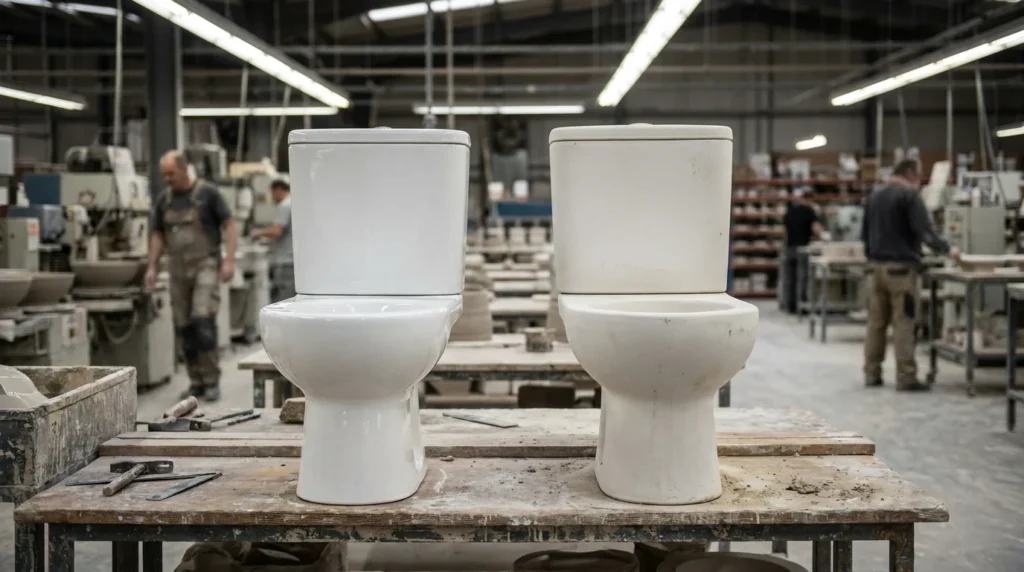
The problem: You requested a sample, it arrived looking exactly like what you wanted — good finish, solid weight, tight tolerances — so you placed the order. Weeks later the container lands, and the bulk stock is noticeably different. Thinner gauge steel. A slightly rougher chrome finish. A valve that doesn’t feel as solid under your thumb. Nothing you can necessarily point to on paper, but enough that you know it’s not the same product you approved.
This isn’t always a scam, and it’s rarely a factory deciding to rip you off outright. It’s usually something more mundane and more preventable — and understanding why it happens is what lets you actually stop it.
Why the gap exists
Samples are made by hand, bulk orders are made by the line. A sample is often produced by a factory’s best technicians, on dedicated equipment, with nobody watching a clock. Bulk production runs through standard tooling at standard speed, with normal staff — and small variances that don’t show up in a single hand-finished piece show up consistently across a few thousand units.
Sampling and production sometimes happen at different facilities. A factory can genuinely produce your sample in-house, then subcontract part or all of the bulk order to a second facility or a different production line when your order competes for capacity with other customers. The sample was real. It’s just not necessarily what actually shipped.
Cost pressure gets applied after the sample is approved, not before. Once you’ve said yes to a sample and price, a factory under margin pressure has an incentive to find savings somewhere in the bulk run — a cheaper plating supplier, a thinner-gauge sheet within the same product spec, a different valve manufacturer that’s “equivalent.” None of it necessarily violates what was agreed on paper, because the sample approval often wasn’t specific enough to prevent it.
“Approximately the same” isn’t the same as “identical.” If your approval process was a visual sign-off rather than a documented spec — measured wall thickness, named component brands, a defined finish standard — there’s nothing actually locking the bulk order to what you approved. The factory isn’t necessarily cheating you; they’re meeting a spec that was never precisely written down.
Where retailers get caught out
Approving on looks alone. A sample that looks right can still hide a thinner gauge, a cheaper internal component, or a coating that won’t hold up to the same wear. Visual approval catches obvious problems and misses the ones that actually cost you money six months later.
Not locking the spec in writing before production. If the purchase order doesn’t reference exact material specifications, component brands, and tolerances tied to the approved sample, there’s no contractual basis to reject a bulk shipment that technically meets a looser reading of what was agreed.
Skipping inspection during production, not just at the end. Waiting until the finished goods are ready to inspect means any problem is already baked into the entire run. By the time you find it, you’re negotiating over a container that’s already built, not correcting a line that’s mid-production.
Treating the first successful order as proof it’ll stay that way. Factories change suppliers, staff, and processes over time, often for reasons that have nothing to do with you. A supplier that shipped a clean order eighteen months ago isn’t a guarantee for the order going through today — the relationship needs ongoing checking, not a one-time trust decision.
What actually prevents this
Turn the approved sample into a written spec, not a memory. Document exact measurements, named components (valve brand and model, not just “quality valve”), material grade, and finish standard at the point you approve the sample — before the purchase order goes in. This becomes the reference point for every inspection afterward.
Keep the sample. A physical retained sample, not just photos, is what an inspector actually checks bulk stock against. Photos flatten exactly the kind of tactile difference — weight, finish texture — that tends to be where the drift shows up.
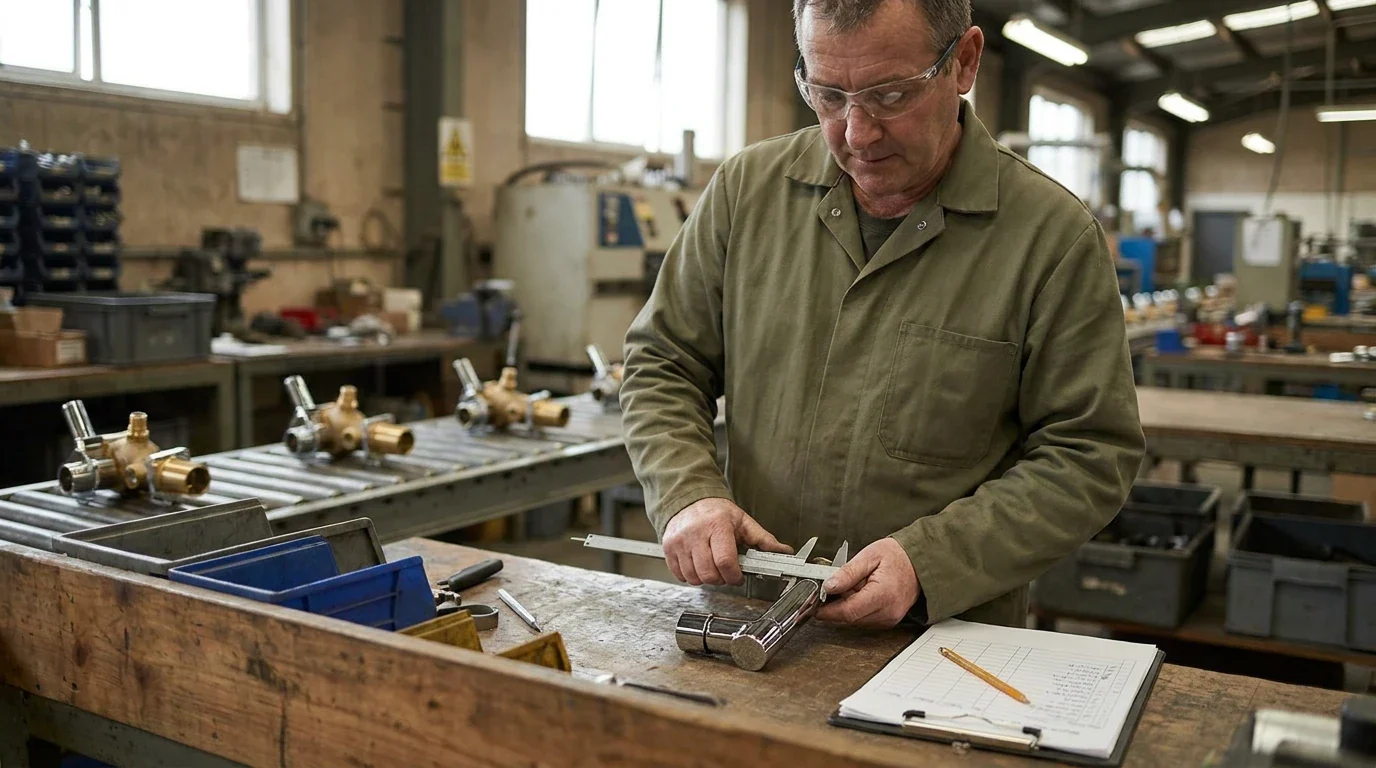
Inspect during production, not just before shipping. A mid-production inspection, checking a run of units partway through the order, catches a problem while there’s still time to fix the line — rather than a pre-shipment inspection that only tells you the whole container is already wrong.
Use an inspector who understands the product category. A generic quality inspection checklist misses category-specific failure points — a WaterMark-relevant sealing surface, a WELS-relevant flow component — that someone who actually knows bathroomware and tapware will catch and someone doing generic QC for a dozen unrelated product types won’t.
What it costs when this goes unchecked
The real cost isn’t the quality difference itself — it’s finding out about it after the container has landed, cleared customs, and started moving to customers. At that point your options are all bad: accept stock you’re not happy with, negotiate a partial refund from a factory that has no reason to be generous once goods have shipped, or eat the cost of freighting a replacement order while your shelf sits empty. None of those outcomes exist if the drift gets caught during production instead of after arrival.
Where this leaves you
Locking a spec, retaining a physical reference sample, and running inspections at the right points in production is a real, learnable process — but it takes someone actually on the ground who knows what to check and when, not a checklist filled out remotely after the fact. This is one of the areas where trying to manage it entirely from Australia, order by order, is genuinely difficult to do well without someone local doing the legwork.
It’s also one of the more straightforward parts of what we do day to day — locking specs against approved samples, running inspections at the stages that actually catch drift, and managing the factory relationship so a quality issue gets fixed on the line instead of discovered in your warehouse. If you’ve had a bulk order come in different to the sample before, it’s worth talking through what actually happened before you place the next one.
Sortex sources bathroom sanitaryware, tapware and kitchen sinks direct from verified factories across Australia, New Zealand and Southeast Asia, with spec-locked quality control managed in-house from sample to shipment. Get in touch to talk through a program.